
Chronicles Of Narnia–C. S. Lewis
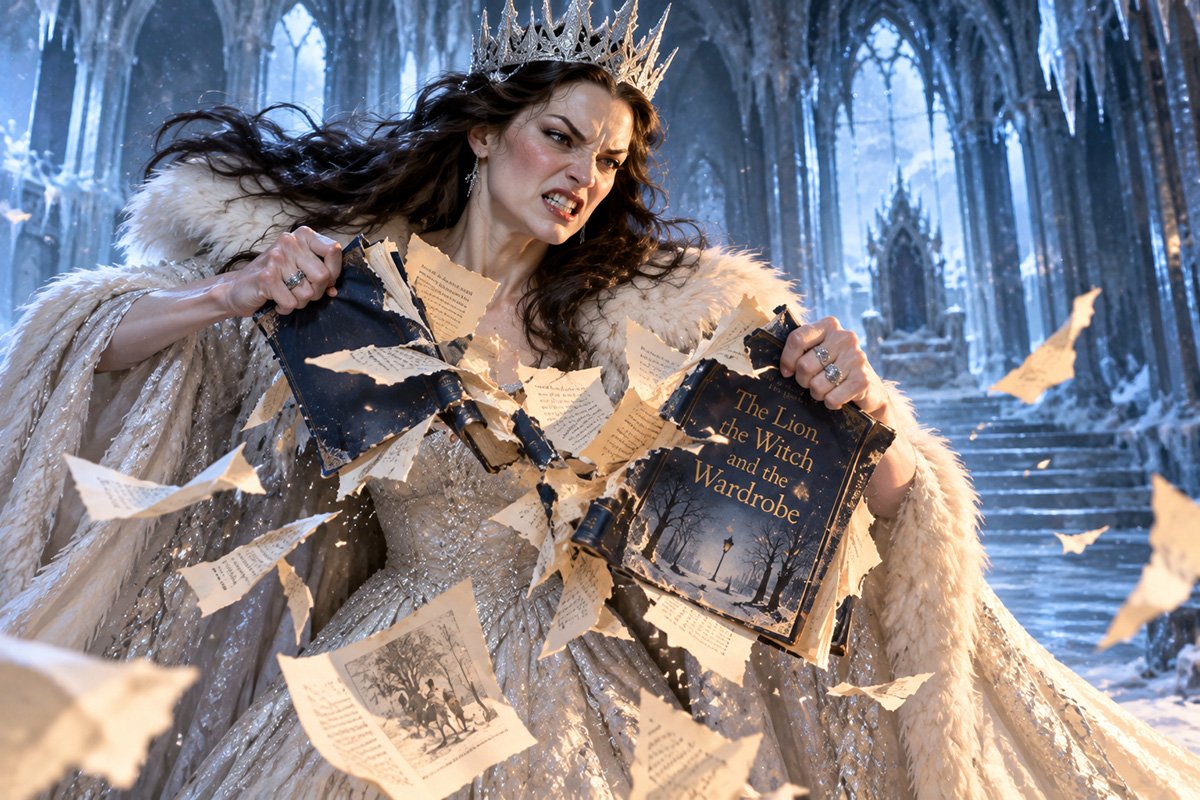
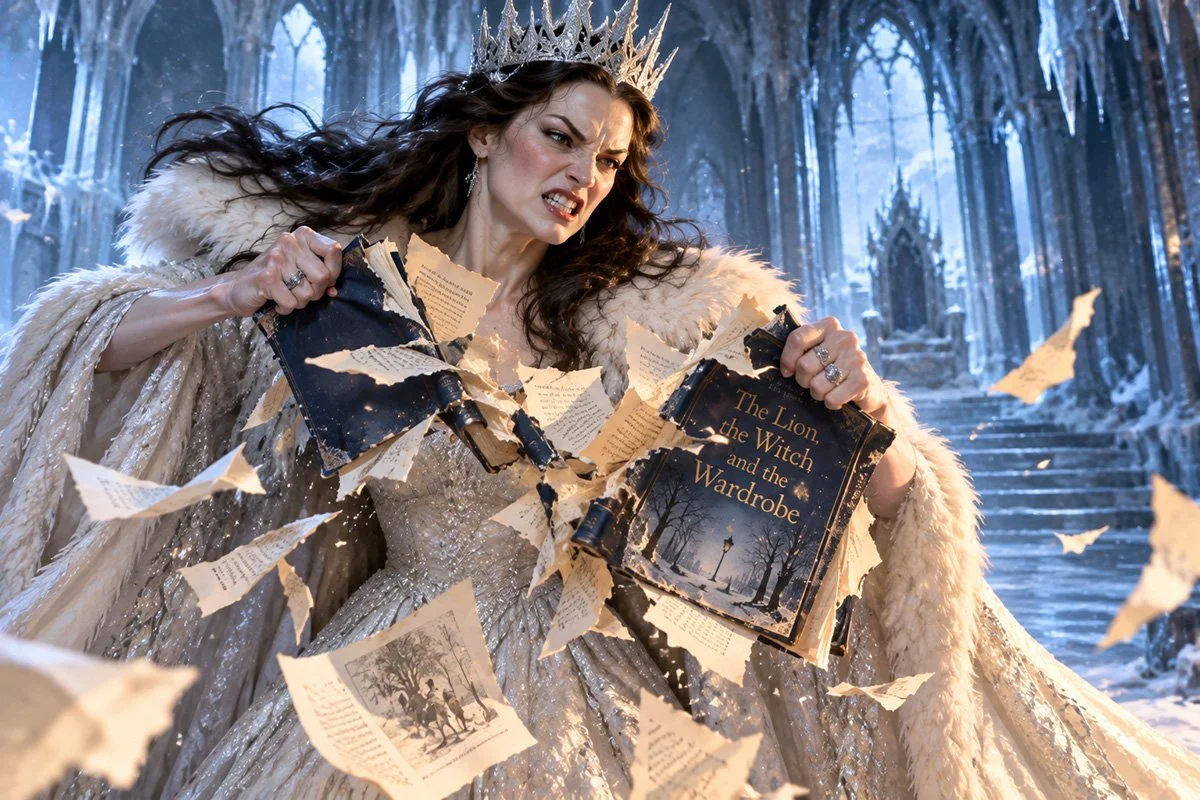
The White Witch has clearly not taken kindly to C. S. Lewis’s The Lion, the Witch and the Wardrobe.
What’s she so all-fired angry about? The book was written after Aslan (the lion) killed her. She acts as if she’s Joan Crawford come back to life, only to be handed a copy of Mommie Dearest and told to “read this.” Then again, Joan wasn’t a witch, as is the woman shredding The Lion, the Witch and the Wardrobe, who could be brought back to life by dark magic, according to the wicked old hag in Prince Caspian, the next story in the Chronicles of Narnia, depending on which side of the “next” controversy you’re on (see what C. S. Lewis had to say about this).
Whether the old hag was right or not, we’ll never know, as we never see the White Witch again. But here’s the point—even though she’s long gone, evil still remains, and without Aslan, the King of all Narnia and beyond, it would prevail, swallow up all our hope and dreams, and consume us all.
Which is one reason I reach for this series when I need a counterweight to the stories that are pulling me down. Though battles rage throughout, as is the case in almost all stories, though troubles never end, as in the case in almost all stories, these stories overflow with hope.
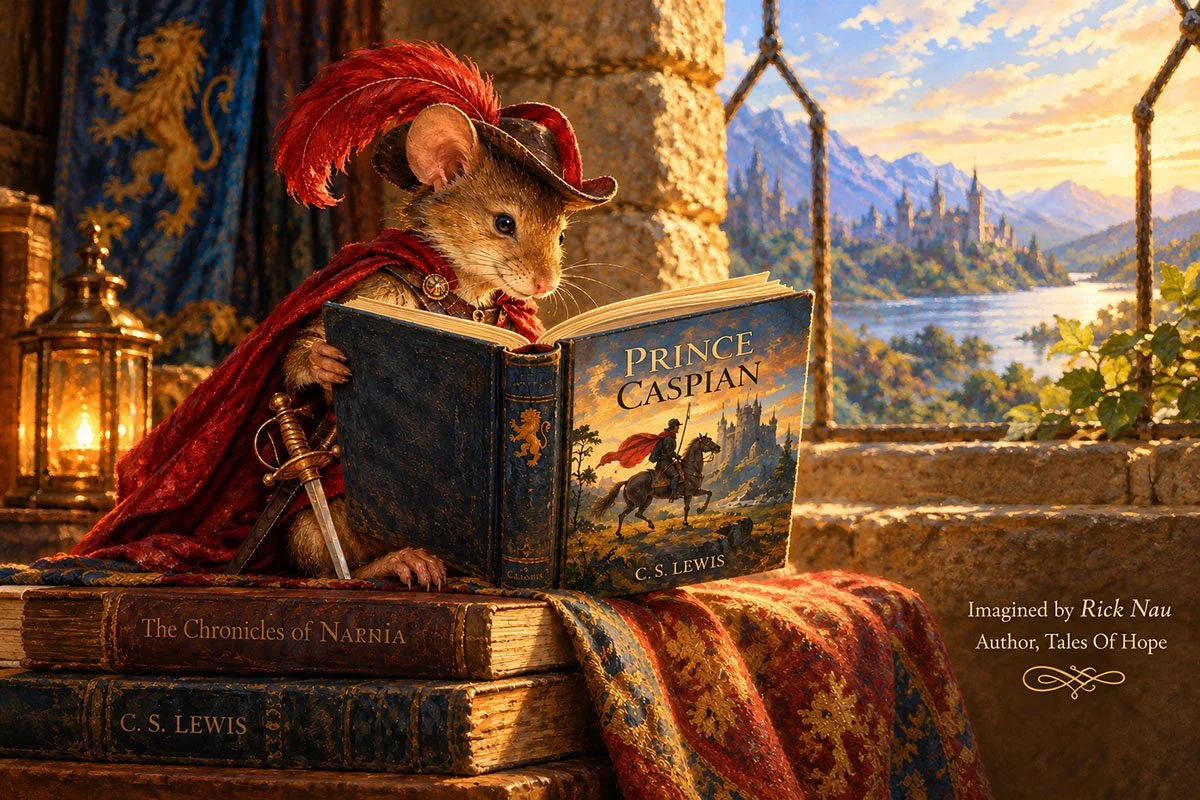
Even a valiant mouse needs a quiet moment with a good book. Here, Reepicheep turns to Prince Caspian—though he knows a thing or two about adventure himself.
For instance . . . I was rereading Conrad’s Heart of Darkness and Anne Brontë’s The Tenant of Wildfell Hall simultaneously. I don’t know whether it was a death wish or not, for Heart of Darkness is the darkest of dark, and Wildfell Hall is packed with sentences as long as the Mississippi and studded with so many fifty-dollar words that if they were all added up they’d easily total a million. In Wildfell’s defense, however, I must say that while it was awfully dark in many, many places, it surprised me most wonderfully at the end. My friend Karen, an avid reader and book lover, summed it up when she wrote, “I think I found the story so romantic because the protagonist (Gilbert) never gives up. He is discouraged to the point of despair, confused as to how to go on, but his love for Helen is so great that he smashed his pride in pursuit of his love.”
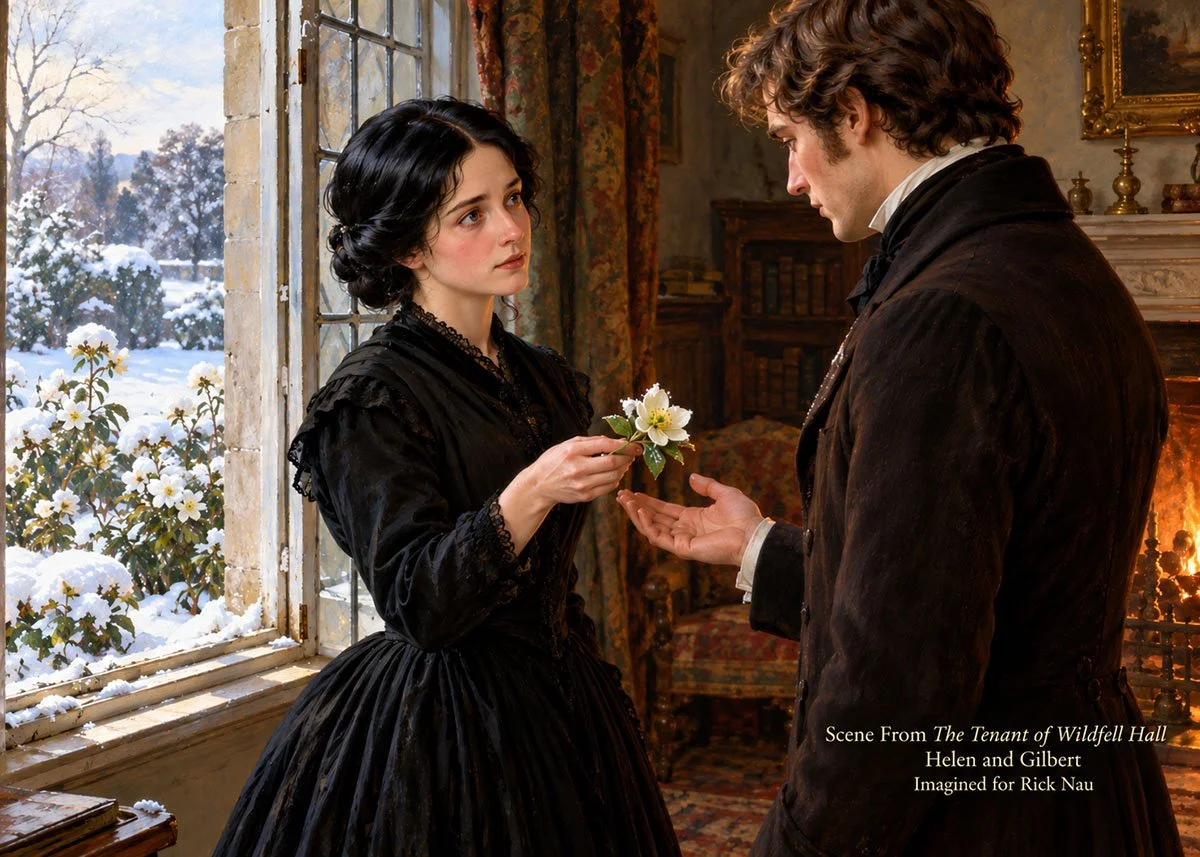
Even in a dark story, love and hope can find a way through. Helen and Gilbert in Anne Brontë’s The Tenant of Wildfell Hall.
I only wish I’d known about the Chronicles when I was in high school. Though we were assigned everything under the sun to read—most of which was dreary and depressing—the name C.S. Lewis and the Chronicles never came up—not even once. I suppose that’s because the stories weren’t considered to be literature, but fairy tales meant for little kids. After all, we were fifteen, soon to be adults, and our teachers felt the need to prepare us for the real world, one in which there was no God, no lion named Aslan, no one to hold our hands through life’s troubles and to say, like Christ, yes, troubles are the norm, but not to worry, I have overcome the world.
Meanwhile, now that high school is thankfully long past, the White Witch is terrorizing London (The Magician’s Nephew), Aslan (the lion) has died and risen from the dead (The Lion, the Witch and the Wardrobe) and the valiant mouse Reepicheep has lost his tail in battle (Prince Caspian), only to have it . . . well, it’s complicated.
Still on the horizon for rereading: The Horse and His Boy, The Voyage of the Dawn Treader, The Silver Chair and The Last Battle.





Netflix is bringing C. S. Lewis’s The Magician’s Nephew to the screen, but will Hollywood capture the true meaning of Aslan? Explore the Christian significance of Lewis’s great Lion and what changes to his portrayal might mean for the world of Narnia.